AI Security Operations
Apply machine intelligence to your security operations: continuous log analysis, baseline learning, automated threat detection, and incident response, deployable on your own infrastructure.
Small security teams face an impossible challenge—monitoring thousands of log events, analyzing access patterns, detecting anomalies, and responding to threats across email systems, servers, applications, and network infrastructure. Manual log review misses sophisticated attacks, creates alert fatigue, and consumes valuable staff time that should focus on strategic security initia...
Discuss Security Automation →
Small security teams face an impossible challenge—monitoring thousands of log events, analyzing access patterns, detecting anomalies, and responding to threats across email systems, servers, applications, and network infrastructure. Manual log review misses sophisticated attacks, creates alert fatigue, and consumes valuable staff time that should focus on strategic security initiatives.
Infinity's AI-Enhanced Security Operations apply machine learning and intelligent automation to security monitoring, threat detection, and incident response. We design custom solutions that analyze log data, identify suspicious patterns, correlate security events, and trigger automated response workflows—providing enterprise-grade security capabilities without requiring dedicated security operations teams.
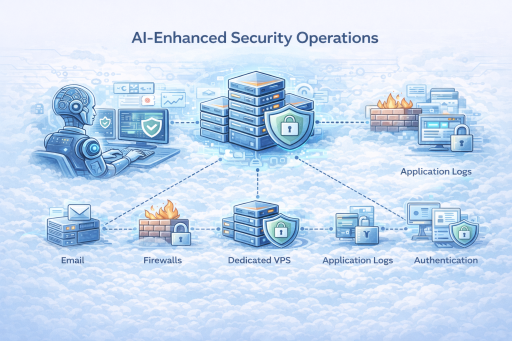
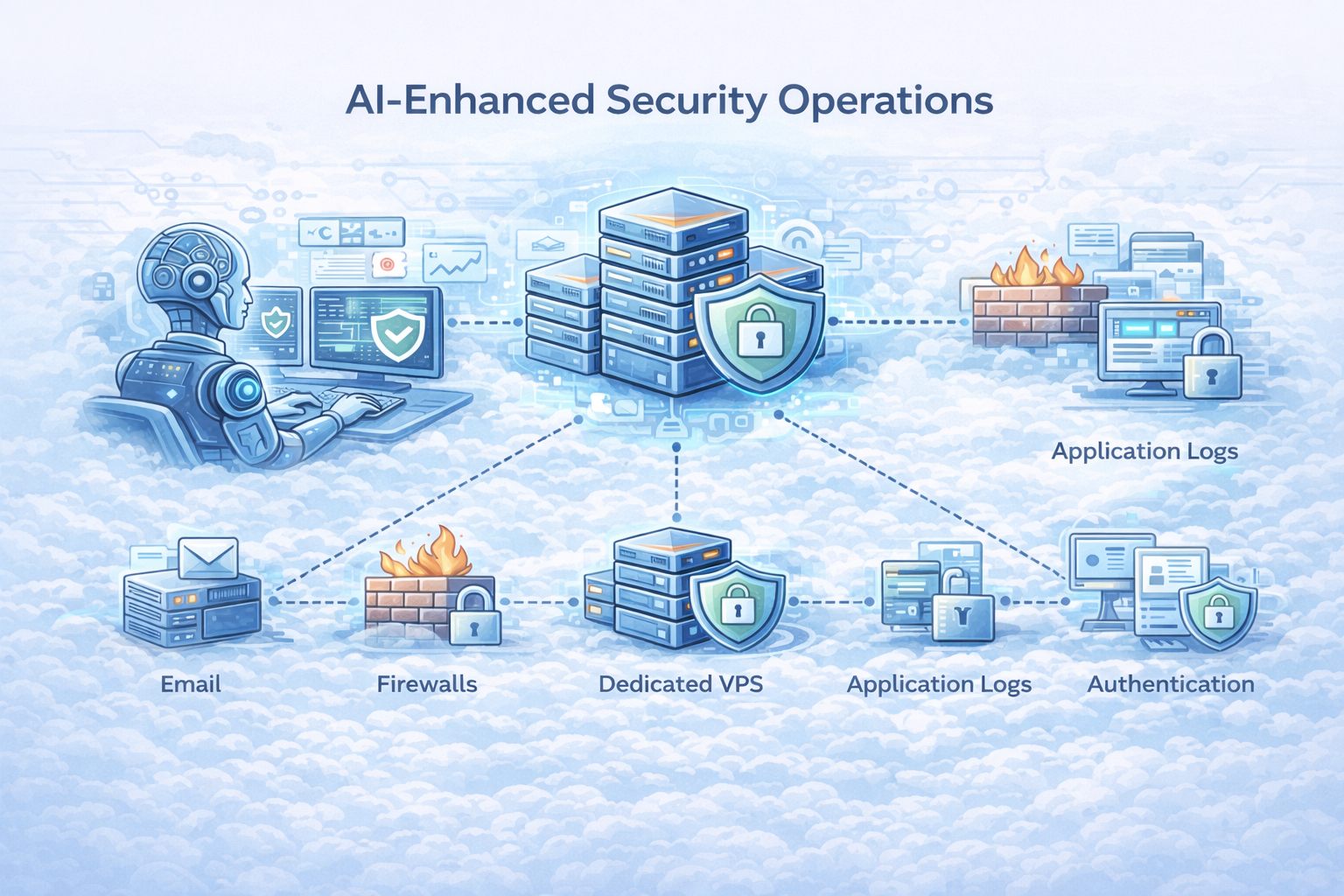
Our security automation solutions integrate with your existing infrastructure—email systems, firewalls, VPS environments, application logs, authentication systems—while adding intelligent analysis layers that detect threats human analysts might miss. Every implementation is tailored to your specific environment, threat landscape, and operational constraints, deployed on dedicated VPS infrastructure that scales with your security monitoring needs.
Discuss Security Automation → Book a Project CallIntelligent Log Analysis & Baseline Learning
Effective security monitoring requires understanding normal system behavior before you can identify anomalies. Our AI-enhanced log analysis solutions establish behavioral baselines for your infrastructure—learning typical access patterns, normal traffic volumes, expected authentication sequences, and routine system operations across your email servers, web applications, VPS instances, and network...
Implement Log Analysis →
Intelligent Log Analysis & Baseline Learning
Effective security monitoring requires understanding normal system behavior before you can identify anomalies. Our AI-enhanced log analysis solutions establish behavioral baselines for your infrastructure—learning typical access patterns, normal traffic volumes, expected authentication sequences, and routine system operations across your email servers, web applications, VPS instances, and network services.
Automated Log Aggregation & Processing: Security logs are scattered across multiple systems—mail server authentication logs, web server access logs, firewall connection logs, application error logs, database query logs, and system event logs. We design centralized log collection systems that aggregate data from all sources, normalize varying log formats, extract relevant security indicators, and prepare data for AI analysis. This aggregation occurs on dedicated VPS infrastructure within your environment, ensuring sensitive log data never leaves your controlled systems.
Pattern Recognition & Anomaly Detection: Machine learning models analyze aggregated logs to identify deviations from established baselines. The system detects unusual login times, unexpected geographic access locations, abnormal email sending patterns, suspicious file access sequences, failed authentication spikes, resource consumption anomalies, and other indicators that suggest security incidents or system compromises. Unlike simple threshold-based alerting, AI analysis considers context, correlates multiple signals, and reduces false positives by understanding what "normal" looks like for your specific environment.
Behavioral Analysis: Beyond simple pattern matching, our solutions track user and system behavior over time—identifying gradual privilege escalation, suspicious lateral movement, data exfiltration patterns, and compromised account indicators. The AI learns how individual users typically behave (working hours, access locations, resource usage) and flags significant deviations that might indicate account compromise or insider threats.
Log analysis solutions integrate with your Email Parsing infrastructure to monitor email-specific security indicators—spam campaigns, phishing attempts, abnormal sending volumes, suspicious attachment patterns—while correlating email activity with broader system behavior for comprehensive threat visibility.
Implement Log Analysis →AI-Powered Threat Detection
Threat detection transforms security monitoring from reactive log review into proactive threat hunting. Our AI-enhanced detection systems identify security incidents in real-time by analyzing patterns across multiple data sources, recognizing attack signatures, and correlating seemingly unrelated events that together indicate compromise or malicious activity.
Email-Based Threat Detection: Email remains the primary attack vector for most organizations....
Deploy Threat Detection →
AI-Powered Threat Detection
Threat detection transforms security monitoring from reactive log review into proactive threat hunting. Our AI-enhanced detection systems identify security incidents in real-time by analyzing patterns across multiple data sources, recognizing attack signatures, and correlating seemingly unrelated events that together indicate compromise or malicious activity.
Email-Based Threat Detection: Email remains the primary attack vector for most organizations. Our detection systems analyze email patterns for phishing campaigns, business email compromise attempts, malware distribution, credential harvesting, and social engineering attacks. The AI examines sender reputation, content patterns, link destinations, attachment characteristics, and recipient targeting to identify malicious messages that bypass traditional spam filters. For organizations using our Email Parsing solutions, threat detection integrates directly with the gateway layer—blocking suspicious messages before delivery while logging incidents for security analysis.
Access & Authentication Monitoring: Compromised credentials represent a critical security risk. Detection systems monitor authentication attempts across email, VPS access, application logins, and administrative interfaces—identifying brute force attacks, credential stuffing campaigns, impossible travel scenarios (logins from geographically distant locations within impossible timeframes), and suspicious authentication patterns. When detection systems identify compromised accounts, automated workflows can trigger immediate password resets, account lockouts, or security team notifications.
System & Application Behavior Analysis: Beyond user activity, our solutions monitor system behavior for indicators of compromise—unexpected process execution, suspicious file modifications, unauthorized software installation, abnormal network connections, privilege escalation attempts, and data access anomalies. This system-level monitoring detects malware, backdoors, rootkits, and advanced persistent threats that operate independently of user accounts.
Threat Intelligence Integration: Detection effectiveness improves when systems understand current threat landscapes. Our solutions can integrate with threat intelligence feeds, known malicious IP databases, phishing URL repositories, and malware signature sources—comparing your environment's activity against known threat indicators and identifying attacks using recognized tactics, techniques, and procedures.
Correlation & Context Analysis: Individual security events often appear benign in isolation but indicate serious threats when correlated. Our AI systems analyze relationships between events—a failed login followed by successful VPN access from a new location, email exfiltration preceding an unusual database query, privilege escalation occurring after suspicious file downloads. This correlation identifies multi-stage attacks that evade single-event detection rules.
Deploy Threat Detection →Automated Incident Response
Detecting threats matters only when you can respond quickly. Our automated response systems execute predefined workflows when security incidents are detected—containing threats, notifying personnel, collecting forensic evidence, and initiating remediation—reducing response times from hours to seconds while ensuring consistent execution of security procedures.
Immediate Threat Containment: For critical security events, automation execut...
Enable Automated Response →
Automated Incident Response
Detecting threats matters only when you can respond quickly. Our automated response systems execute predefined workflows when security incidents are detected—containing threats, notifying personnel, collecting forensic evidence, and initiating remediation—reducing response times from hours to seconds while ensuring consistent execution of security procedures.
Immediate Threat Containment: For critical security events, automation executes immediate containment actions without waiting for human intervention. Compromised accounts can be automatically disabled, suspicious network connections blocked, malicious processes terminated, and affected systems isolated from the network. These automated containment actions stop attacks in progress while security teams investigate and plan remediation strategies.
Intelligent Alerting & Escalation: Not all security events require immediate human response, but critical incidents need rapid escalation to appropriate personnel. Our response systems implement intelligent alerting workflows—low-severity events are logged for batch review, medium-severity incidents trigger email or chat notifications to security staff, high-severity threats initiate immediate escalation via SMS, phone calls, or paging systems. Alert content includes relevant context, affected systems, detected patterns, and recommended response actions—enabling faster triage and decision-making.
Forensic Evidence Collection: When security incidents occur, preserving evidence is critical for investigation, remediation, and potential legal proceedings. Automated response workflows capture relevant log data, create system snapshots, preserve network traffic captures, record user activity, and collect other forensic artifacts before evidence is lost to log rotation, system reboots, or attacker cleanup actions. This automated evidence collection ensures complete incident documentation while reducing the manual effort required from security teams.
Integration with Security Tools: Response automation integrates with your existing security infrastructure—firewall rule updates, IDS/IPS signature deployment, endpoint protection policy changes, and backup system triggers. Workflows can also integrate with ticketing systems to create incident records, collaboration platforms to notify teams, and compliance reporting systems to document security events for audit requirements.
Workflow Orchestration: Complex incident response procedures involve multiple steps, conditional logic, and coordination across systems. We implement response workflows on the same automation platform that powers our Email Parsing solutions. This allows sophisticated response scenarios: if authentication anomaly detected AND user is administrator THEN disable account AND notify security team AND create high-priority ticket AND preserve login logs. Workflows handle error conditions, implement retry logic, and maintain complete audit trails of all automated actions.
Response Validation & Feedback Loops: Automated response systems improve over time by learning from incident outcomes. Our solutions implement feedback mechanisms where security teams review automated actions, confirm threat assessments, and adjust response thresholds. This continuous improvement reduces false positives while ensuring response actions remain appropriate for your evolving threat environment.
Enable Automated Response →Custom Security Solutions & VPS Deployment
AI-enhanced security operations are delivered as custom-designed systems built on dedicated VPS infrastructure. Unlike generic security platforms with fixed features, we design each implementation around your specific infrastructure, threat profile, operational constraints, and security requirements.
Discovery & Threat Assessment: Every security automation project begins with comprehensive environment assessment to understand your...
Start Security Assessment →
Custom Security Solutions & VPS Deployment
AI-enhanced security operations are delivered as custom-designed systems built on dedicated VPS infrastructure. Unlike generic security platforms with fixed features, we design each implementation around your specific infrastructure, threat profile, operational constraints, and security requirements.
Discovery & Threat Assessment: Every security automation project begins with comprehensive environment assessment to understand your current security posture, identify monitoring gaps, document critical assets, analyze threat exposure, and define incident response requirements. We review existing log sources, evaluate security tool coverage, identify high-value monitoring targets, and establish baseline security metrics. This assessment ensures the final solution addresses your actual security risks rather than implementing generic monitoring that generates noise without actionable intelligence.
VPS-Based Security Infrastructure: Security monitoring solutions deploy on dedicated VPS infrastructure sized for your log volume and analysis requirements. Small deployments monitoring single servers or basic email infrastructure might run on shared VPS environments with isolated security containers. Organizations with complex infrastructure, high log volumes, or strict data residency requirements deploy on fully dedicated VPS instances with guaranteed resources for consistent analysis performance. High-security environments can utilize air-gapped Proxmox nodes with complete hardware isolation for maximum security assurance.
VPS deployment keeps all security data within your controlled environment—logs never transit third-party services, analysis occurs on your infrastructure, and sensitive security information remains under your direct control. This architecture satisfies compliance frameworks that prohibit external security monitoring services while providing the advanced capabilities typically available only from managed SIEM platforms.
Local AI Processing: Organizations with strict data privacy requirements or concerns about security data exposure can deploy security AI using local language models running on dedicated VPS or Proxmox infrastructure. This approach keeps all log analysis, threat detection logic, and security intelligence within your private environment—security data never leaves your systems. We're developing local AI security capabilities as part of our broader Local AI & Automation services, with particular focus on regulated industries and high-security deployments.
Integration with Existing Security Stack: Our solutions complement rather than replace your existing security infrastructure. We integrate with email security filters, firewall systems, intrusion detection platforms, endpoint protection tools, and authentication systems—adding AI analysis layers that enhance rather than duplicate existing capabilities. For organizations using our Email Parsing solutions, security monitoring extends naturally into the email gateway—analyzing parsed email data for security indicators while correlating email activity with broader system behavior.
Scalable Monitoring Architecture: Security monitoring needs grow as organizations expand infrastructure, add services, and face evolving threats. Our VPS-based architecture scales incrementally—adding monitoring agents for new systems, expanding log storage capacity, increasing analysis resources, or implementing additional detection capabilities—without requiring platform migrations or architectural changes. Organizations start with focused monitoring of critical systems and expand coverage as security programs mature.
Implementation & Tuning: We provide complete implementation services including log source configuration, baseline establishment, detection rule development, response workflow design, integration testing, and security team training. Initial deployments include tuning periods where we adjust detection thresholds, refine alert rules, optimize response workflows, and eliminate false positives—ensuring the system provides actionable security intelligence rather than overwhelming teams with noise.
Ongoing Support & Evolution: Security threats evolve constantly, requiring monitoring systems that adapt to changing attack patterns. After deployment, we provide ongoing support for detection rule updates, new threat integration, workflow optimization, and monitoring expansion. As your infrastructure changes or threat landscape shifts, monitoring logic can be modified without system rebuilds—maintaining effective security coverage through continuous adaptation.
Ready to Enhance Your Security Operations?
AI-enhanced security monitoring solutions are custom-designed for your specific infrastructure and threat environment. We'll work with you to assess your security monitoring needs and design automation that provides actionable threat intelligence without overwhelming your team.
Put AI to work on your security operations
Tell us about your environment and we will scope a deployment that fits.
Request a Consultation Schedule a Discovery CallStart here
Infrastructure Health Check — $750
A written review of what you are running now, where it will break, and what to do about it in what order.
What you get back
- Current architecture documented, including the parts nobody wrote down
- Single points of failure identified and ranked by likely impact
- Capacity headroom on compute, storage, power and bandwidth
- A twelve-month roadmap with rough costs, usable for budgeting
Turnaround one to two weeks. If you go ahead with the work it recommends, the fee is credited against it in full.
Request the Infrastructure Health Check See consulting ratesTell us about your AI security operations needs
Describe your situation and we will look into it and get back to you.
Describe Your Challenge Schedule a Call